Beyond Conway’s Game of Life: Designing a Living World in Rust
From classic cellular automata to predator–prey interactions, vegetation, disasters, and evolving ecosystems: the design challenges behind an ambitious simulation concept in Rust.
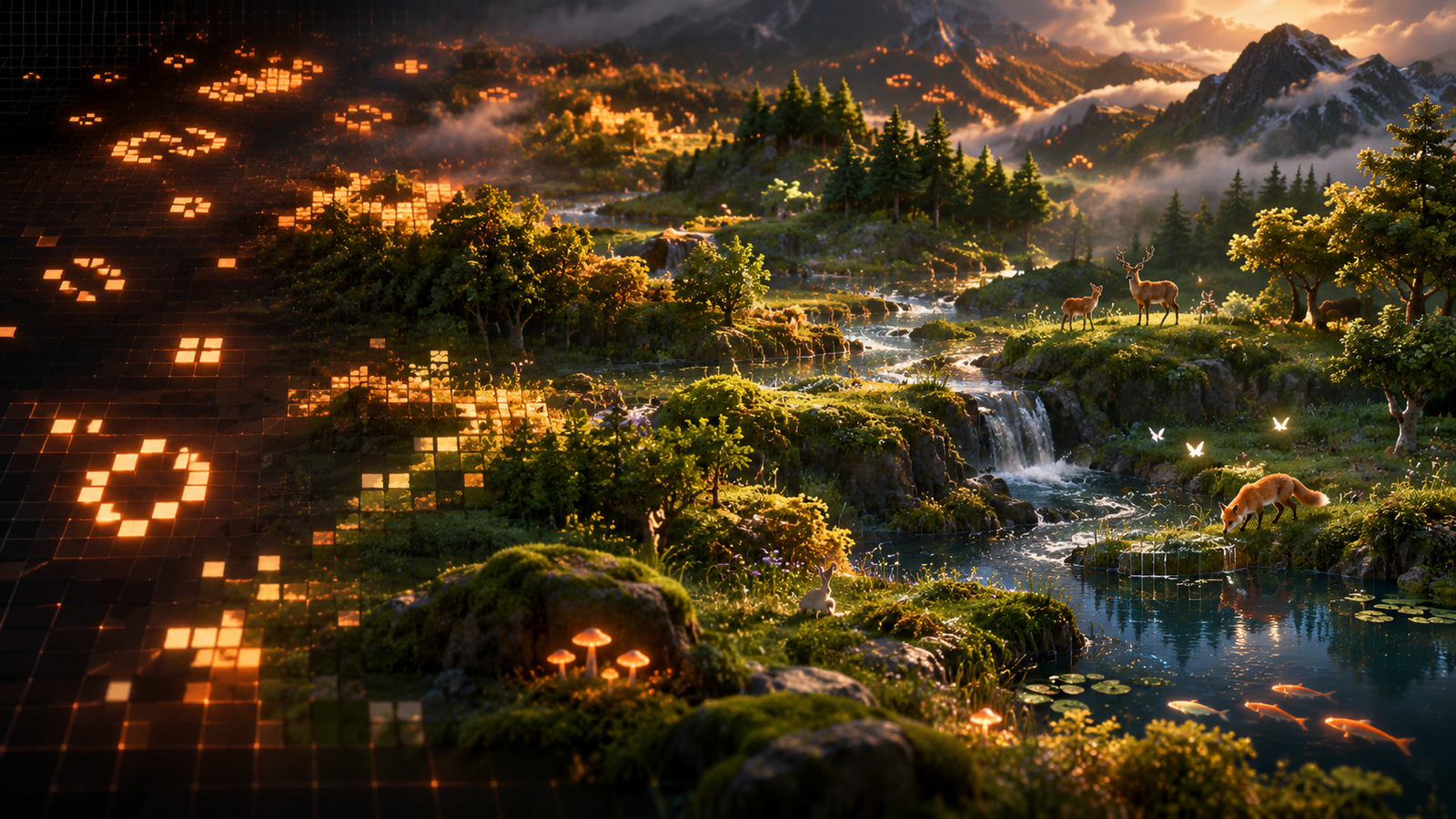
A few simple rules can create surprisingly complicated behavior. That's the magic of Conway's Game of Life: each cell is alive or dead, and the next generation depends only on its neighbors. Yet those rules produce oscillators, gliders, collisions, and structures that appear almost engineered.
I've been exploring a broader project idea built around that principle: a simulation platform in Rust that begins with the original Game of Life and expands into ecosystems, environmental processes, and more complex forms of artificial life.
The attraction is the same in both cases: interesting global behavior emerging from local rules.
Start with the original, not an approximation
The classical version deserves its own complete mode. Users should be able to change grid dimensions, choose boundary conditions, place cells manually, load famous patterns, and explore the system generation by generation.
A finite world needs clear edge rules. Wrapping the grid into a torus, for example, creates different dynamics from treating everything beyond the border as dead. An effectively infinite world introduces another engineering challenge: we cannot allocate an endless matrix.
For sparse worlds, storing only active cells can be efficient. Dense regions may benefit from compact arrays or bit-packed representations. Switching strategies intelligently could be one of the interesting optimization problems.
I would also want the simulator to distinguish between the simulation step rate and the rendering frame rate. Fast-forwarding millions of generations should not require drawing every intermediate state.
A second mode: ecosystems instead of cells
The more ambitious part is an ecological simulation containing plants, fungi, herbivores, carnivores, omnivores, predators, and environmental conditions.
At that point, this is no longer Conway's original automaton. It becomes a different model, potentially combining discrete grids, agent-based simulation, and resource dynamics.
That distinction is important. A predator cannot be represented adequately by a cell that merely changes color. It may need energy reserves, hunger, sensory range, movement rules, reproduction, and a way to respond to threats.
Plants would compete for light, water, and nutrients. Herbivores would move toward food. Predators would hunt, but spend energy doing so. Decomposition could return resources to the environment.
Even a small set of carefully chosen rules can produce interesting outcomes: population cycles, migration, local collapse, and competition for limited resources.
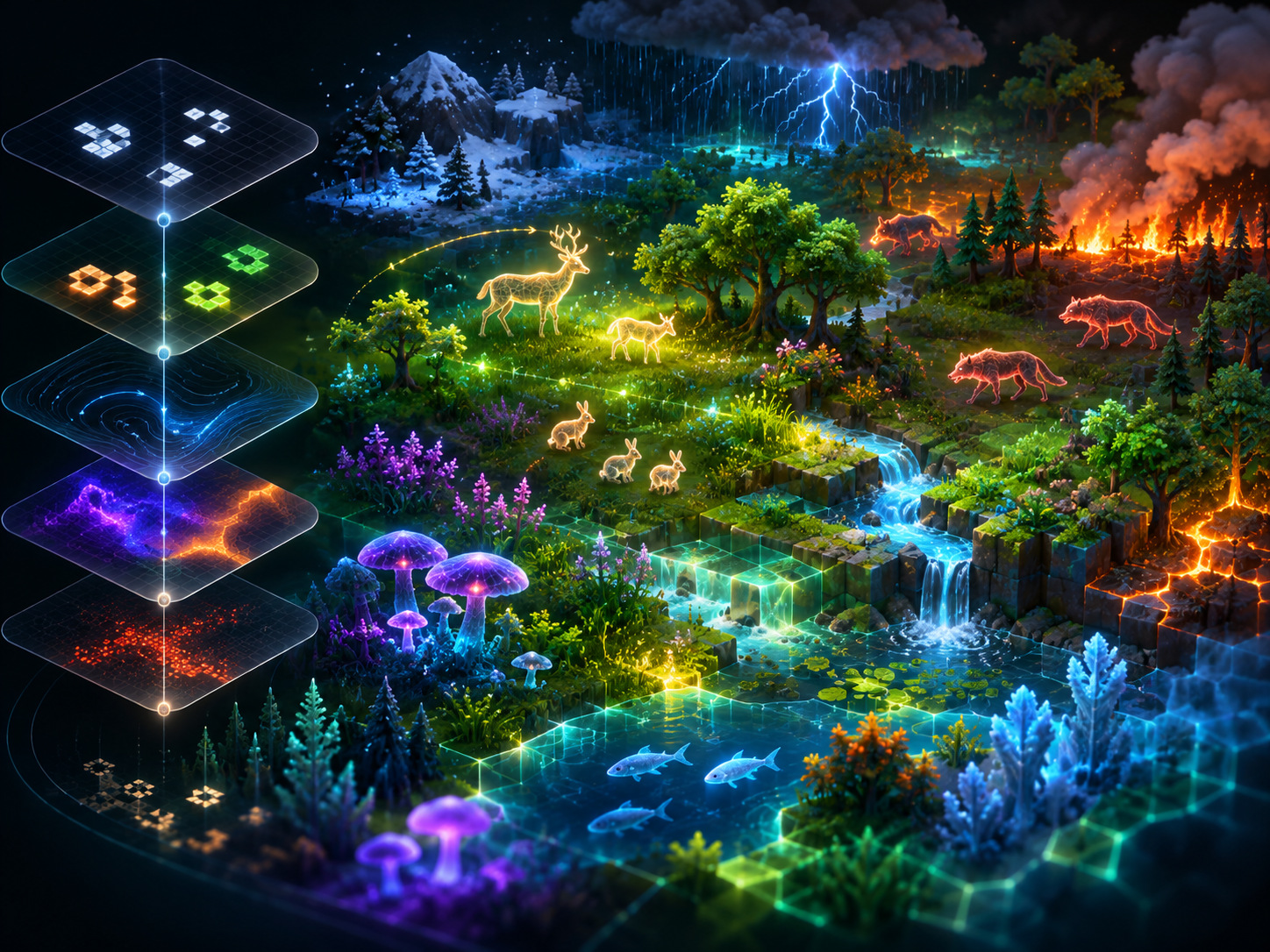
Adding weather and disasters
Environmental events are especially interesting because they affect many agents simultaneously.
A fire might spread according to wind, humidity, and available vegetation. A flood might follow elevation. Drought could change plant growth and indirectly affect animal populations.
It would be tempting to add earthquakes, tornadoes, seasons, and every possible creature immediately. But simulation design benefits from restraint. Each mechanic should have a defined role and measurable effects; otherwise, complexity becomes noise.
I would introduce features in layers: vegetation first, then simple herbivores, then predators, then reproduction, then environmental disruptions.
Why Rust appeals to me here
A simulation can require updating large numbers of entities at predictable intervals. Rust is appealing for its performance, memory safety, and explicit data modeling.
An entity-component-system (ECS) approach could separate data such as position, energy, metabolism, and movement from the rules operating on that data. But ECS is not automatically the right answer for every mode. A classic cellular automaton may be faster and simpler with a dedicated grid engine.
The architecture should support different simulation backends rather than force every model into one representation.
Deterministic random seeds would also be valuable. With the same initial state and seed, researchers and players should be able to reproduce a run, compare rule changes, and track why an ecosystem collapsed.
Making complexity understandable
Visual quality matters, but clarity matters more. I want animals, plants, and environmental events to have recognizable visual representations and expressive animation rather than appear as arbitrary colored squares.
Still, detailed graphics can hide the system's logic. A good simulator should let users switch between an immersive view and analytical overlays: heat maps of energy, resource distribution, population charts, and trails showing movement.
A beautiful ecosystem is entertaining. An observable one is educational.
The bigger question
The most compelling outcome would not be a perfectly realistic digital forest. It would be a sandbox where we can ask meaningful questions: what happens if a predator disappears? How does drought alter competition? Can a simple local rule stabilize a population?
The real challenge is not adding more creatures. It's designing rules whose consequences are worth exploring.