When AI Leaves the Screen: The Promise of Gemini Robotics 2
Vision-language-action models are beginning to connect perception, reasoning, and robot movement. A look at Gemini Robotics 2, physical-world uncertainty, and the engineering problems beyond a polished demo.
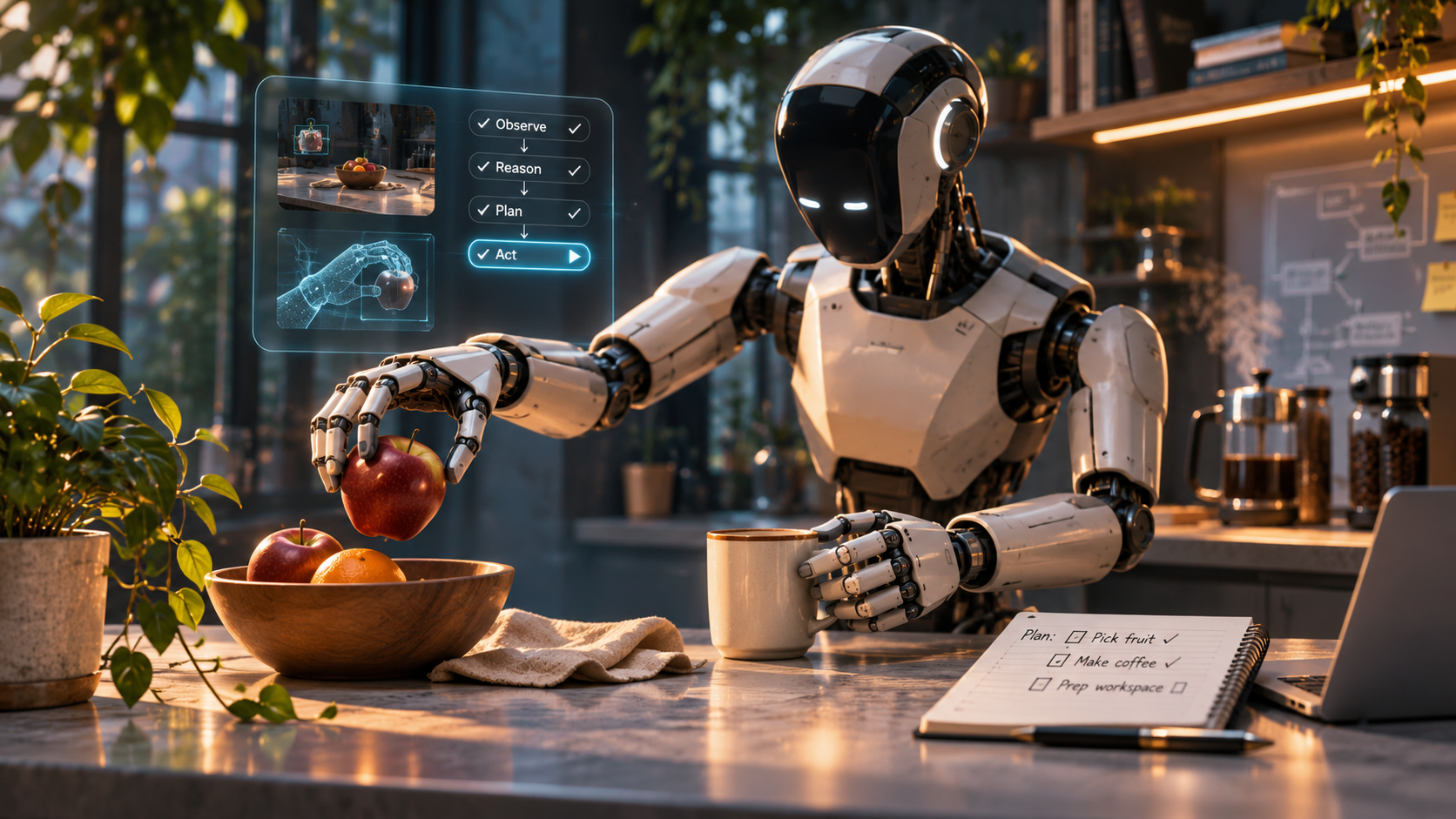
For years, most impressive AI interactions have happened on screens. We type a question, receive an answer, or watch a model generate an image. Robotics introduces an entirely different level of difficulty: the system must make decisions that change the physical world.
On 30 July 2026, Google DeepMind introduced Gemini Robotics 2, describing advances in whole-body control, dexterous manipulation, and coordination across robotic systems.
The broader research direction is often described as vision-language-action, or VLA: models that connect what a robot sees, what it is asked to do, and the actions it should perform.
Why language alone isn't enough
A robot asked to “pick up the blue cup” needs several abilities simultaneously. It must identify the cup, estimate its position, plan a safe approach, select a grip, move its arm, adjust to uncertainty, and stop if something changes.
The instruction is linguistic, but the execution is spatial and physical.
Traditional robot systems often divide these problems into perception, planning, control, and feedback. Learned systems can connect some of these steps more closely, but the need for reliable sensing and control never disappears.
A convincing video of a robot completing a task is therefore just one piece of evidence. Real deployments require consistency across many attempts, environments, and unexpected situations.
What is a vision-language-action model?
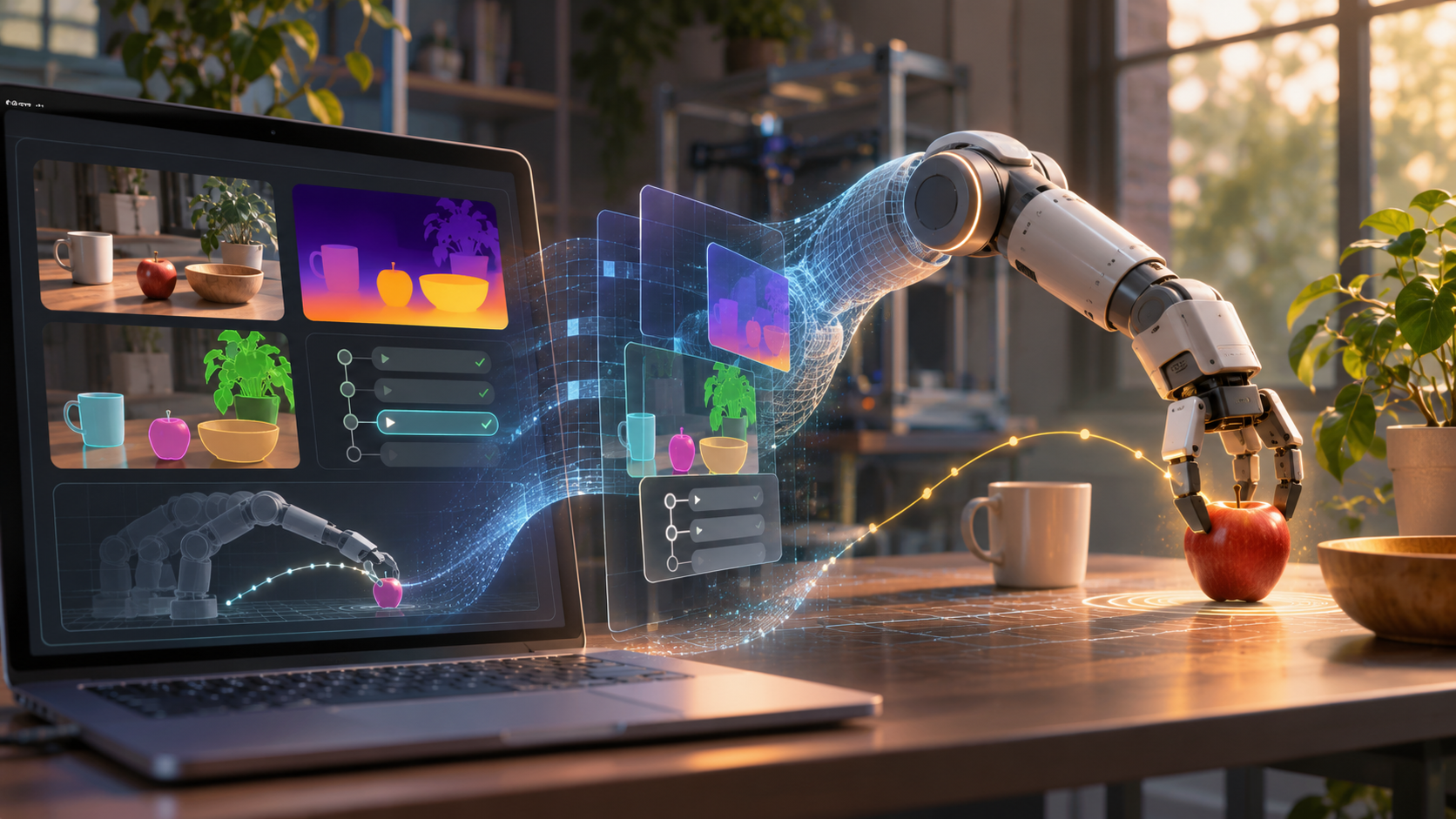
A VLA model accepts information about the environment, interprets instructions, and produces representations of actions that can guide a robot.
This is conceptually different from asking a language model to describe what the robot should do. The output must ultimately be translated into movement under hardware constraints.
Those constraints include joint limits, balance, obstacles, actuator speed, and the possibility of imperfect sensors. A request that sounds simple may require many tightly coordinated control decisions.
The Gemini Robotics 2 announcement discusses systems that connect multimodal understanding to whole-body robot behavior. DeepMind also described an on-device variant intended for local robotic manipulation, with access limited to selected testers at announcement time.
Why local inference matters in robotics
Latency is much more significant when an AI system controls a moving machine. A delayed answer in a chat interface may be annoying; a delayed motor decision can be dangerous.
Local models can reduce some communication delays and network dependencies. But not all reasoning needs to run at the same speed. A robot might use a slower planning system for high-level tasks and a faster feedback controller for real-time movement.
This layered design is familiar in robotics and remains useful even as machine-learning models become more capable.
Generalization is the hardest test
A robot that succeeds in a well-lit laboratory may struggle with different objects, unfamiliar rooms, poor lighting, reflective surfaces, or unexpected people.
General-purpose robotics requires the system to handle changes it has not encountered during training. This is a difficult problem because physical environments contain enormous variation.
The gap between a demonstration and a robust product should be measured through repeated trials, failure recovery, and safety testing—not inferred from a short showcase.
Safety needs to be part of the architecture
Robots can exert force, carry objects, and move near people. That makes safety a central engineering requirement, not a feature added after the model is trained.
A sensible system includes constraints outside the learned model: emergency stops, motion limits, collision checks, restricted operating zones, and human oversight when necessary.
It should also know when to refuse or interrupt an action. A robot that confidently attempts an impossible or unsafe request is less useful than one that recognizes uncertainty.
Why I find this direction exciting
Physical AI connects disciplines that are often studied separately: computer vision, language processing, control theory, reinforcement learning, and distributed systems.
It also changes how we define intelligence. Answering a question correctly is one capability. Acting reliably in a messy, changing environment is another.
I think the next important advances will involve not only more capable models, but better ways to evaluate their behavior in the real world, transfer skills across hardware, and recover safely from mistakes.
The goal isn't a robot that looks intelligent once. It's a robot that can be trusted to behave usefully, repeatedly, and safely.