Teaching a Computer to Understand a Chessboard
Exploring the computer vision, game-state reconstruction, chess engines, and cloud engineering behind my Chess Assistant AI project—and why seeing a board is not the same as understanding a game.
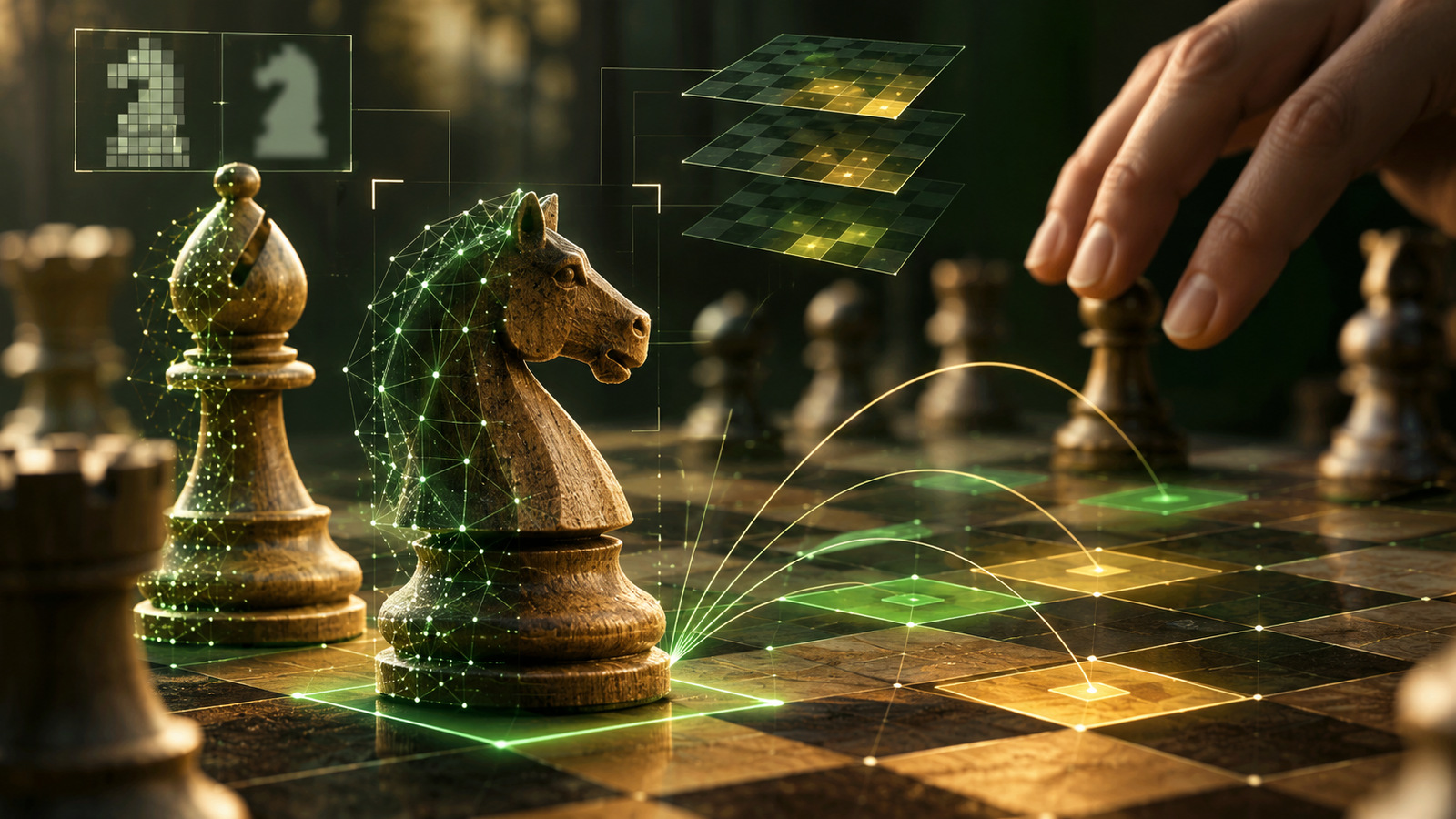
Chess is a surprisingly good test of what it means for a machine to understand the world. At first glance, a chessboard is just an eight-by-eight grid with familiar pieces. But a useful chess assistant must translate pixels into a legal, meaningful game state before it can suggest anything intelligent.
That challenge is why I became interested in Chess Assistant AI, a project connecting computer vision, chess logic, and cloud-based infrastructure.
The interesting question isn't merely, “Can a model recognize a knight?” It's, “Can an entire system infer enough about the position to reason about the next move?”
The gap between an image and a game state
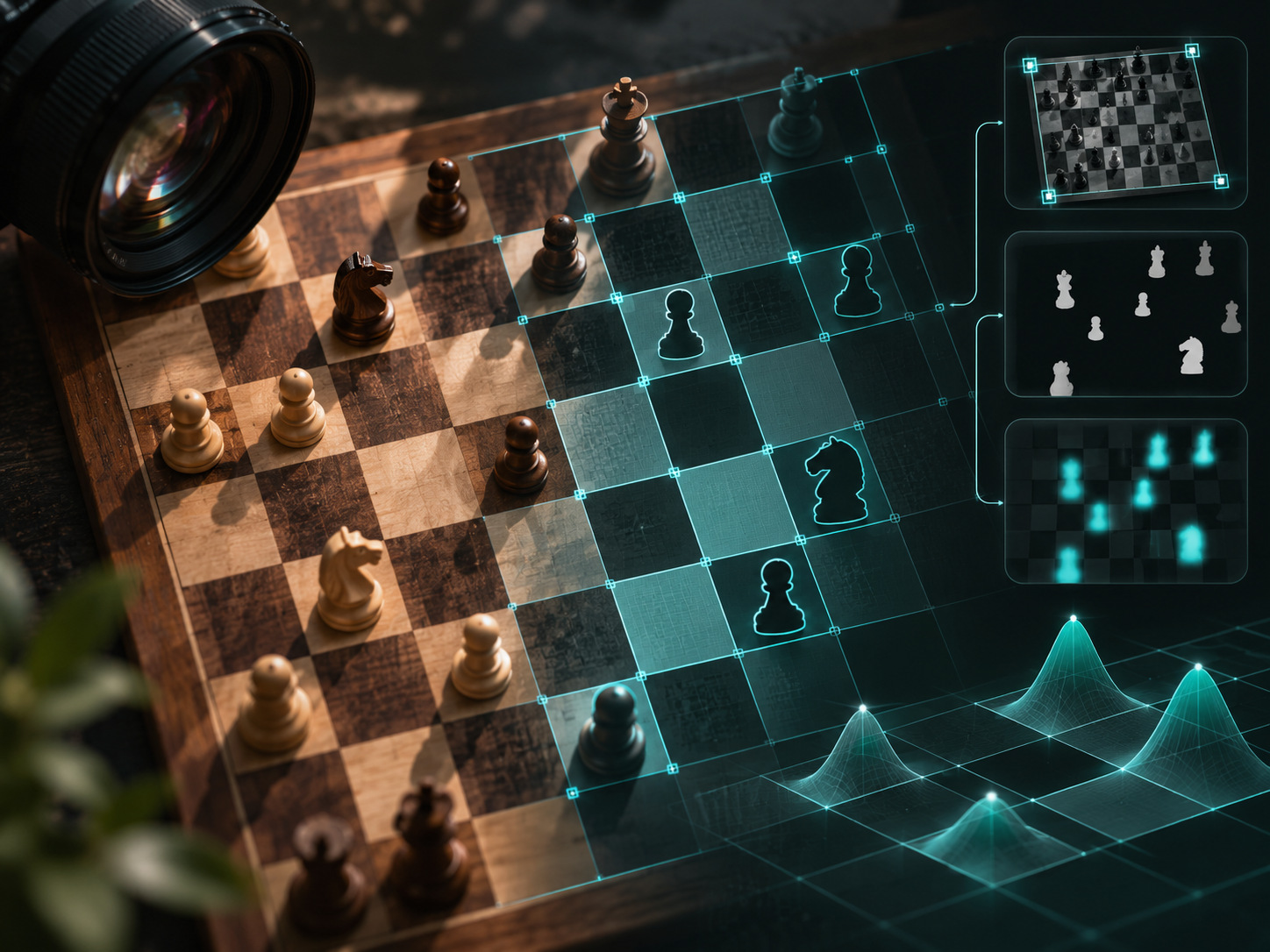
A screenshot contains visual information, not a formal chess position. The application must identify the board, understand its orientation, locate pieces, and associate each piece with a square.
Even after doing all of that, it may still be missing vital details. A single image does not necessarily reveal whose turn it is, whether castling rights remain, whether an en passant capture is legal, or how many moves have passed without a pawn move or capture.
This is a broader lesson in AI: recognition is not the same as understanding. A model can correctly label objects and still fail to reconstruct the state needed for decision-making.
Breaking the problem into stages
A useful architecture separates perception from chess rules and decision-making.
Visual input: capture an image or screenshot, identify the board boundaries, normalize perspective when necessary, and divide the board into squares.
Piece recognition: detect which pieces occupy those squares. Confidence scores are useful here; uncertainty should be represented rather than hidden.
State reconstruction: translate visual predictions into a board representation, then check for impossible or inconsistent positions. Previous frames or user-supplied game details can resolve ambiguities that one image cannot.
Chess analysis: pass a valid position to an engine or analysis algorithm. The engine's output should be accompanied by an explanation a human can understand, rather than an unexplained move recommendation.
Interface: communicate analysis clearly, with arrows, candidate variations, and a way to correct mistakes in perception.
Each stage has different failure modes, which means each needs its own tests.
Why chess engines and AI models play different roles
A search-based chess engine and a neural vision model solve fundamentally different problems.
A vision model estimates what is present in an image. A chess engine evaluates possible futures under strict rules. Combining them does not make either component magically reliable.
Imagine that the recognizer confuses a bishop with a pawn. A very strong engine can then produce an excellent recommendation for the wrong position. The overall system is only as trustworthy as the state it receives.
This is why I find constrained, modular designs attractive. Chess has a well-defined rule system, so rules can validate model predictions. The application shouldn't ask a language model to invent the rules of the game when a deterministic chess library can check them.
Where cloud engineering enters the picture
The project also explores the relationship between local computer vision and services hosted on AWS, including infrastructure such as EC2 and S3.
Not every part of a chess assistant needs a remote server. Lightweight image processing and board interaction can run close to the user. More expensive analysis, persistent assets, or experiments may benefit from cloud resources.
The important engineering decision is defining clear boundaries: which computations require low latency, what needs to be stored, and what data is worth transferring. A cloud-based design should also account for operating costs, timeouts, access permissions, and resilience when a service becomes unavailable.
How I would evaluate it
A single accuracy percentage would tell only part of the story. I would separate evaluation into distinct tasks:
- Board localization: was the grid found correctly?
- Square classification: which pieces, if any, were assigned to each square?
- Whole-position reconstruction: was the complete board correct?
- Legal-state consistency: was the state usable by a rules engine?
- End-to-end usefulness: did the assistant deliver a correct, understandable response?
The whole-position metric is particularly demanding. Small per-square error rates can compound when the system must correctly interpret 64 squares simultaneously.
Beyond chess
What makes this project interesting to me is that the same architectural pattern appears elsewhere: inspect the world, build a structured representation, validate it, and then choose an action.
That pattern is useful in robotics, document analysis, browser automation, and many AI agents. Chess simply provides a compact environment in which the rules are precise and mistakes are easy to identify.
A powerful model is useful. A reliable chain from observation to verified action is what makes it a system.