Building My Own AI Ecosystem
A look at how I'm building practical AI-powered applications for macOS, connecting voice assistants, automation, and everyday tools—and what I've learned along the way.
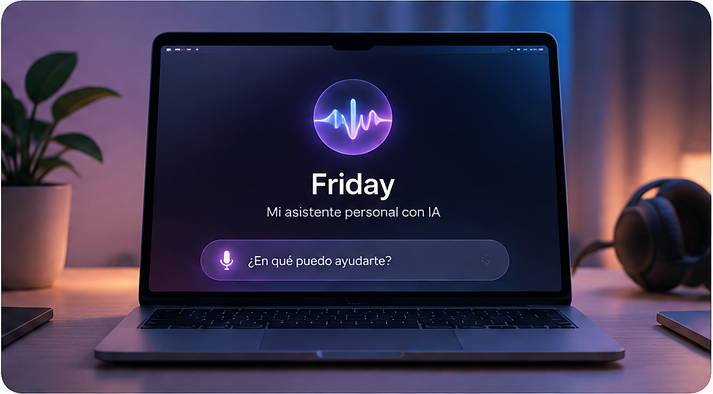
Over the past few months, I've been working on several projects that started with a simple question: what if I could build my own software ecosystem, designed around the way I actually work?
Rather than switching between dozens of applications, I wanted to explore how artificial intelligence could connect them, understand natural language, and help automate everyday tasks.
What began as a collection of independent experiments has gradually evolved into something more ambitious: a personal ecosystem of AI-powered tools.
Starting Small: Solving Real Problems
I've always enjoyed building software that solves problems I encounter myself. Some of my projects started because an existing application was too limited, too expensive, or simply didn't work the way I wanted.
A few examples include:
- Friday: A macOS personal assistant project that brings together voice recognition, natural-language commands, and integrations with applications and system services.
- Interview Preparation: An interactive study application combining structured questions, spoken practice, and AI-powered feedback.
- SwapIT: A collection of local utilities for converting files, manipulating media, and handling repetitive tasks.
- Job Search Automation: An ongoing experiment in automating job discovery, application workflows, and tracking.
Although these projects address different problems, they share an important principle: software should adapt to the user, not the other way around.
The Challenge of Building a Real AI Assistant
One of the most interesting projects has been Friday, my attempt to create a genuinely useful personal assistant for macOS.
The goal isn't simply to build another chatbot. I want an assistant capable of understanding requests such as:
"Find the document I was working on yesterday, remind me to finish it tomorrow, and play something while I work."
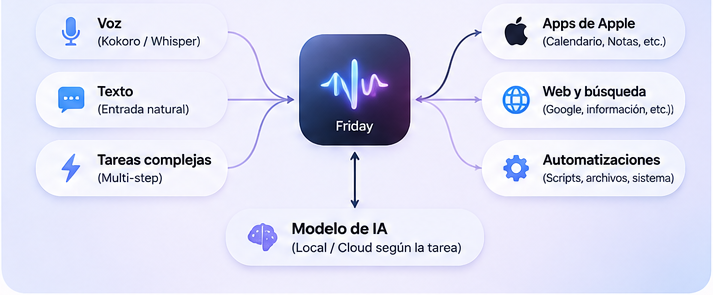
A request like this involves several independent capabilities: language understanding, context management, file discovery, task scheduling, and application control.
The challenge is making these components work together reliably.
I've been exploring a modular architecture that separates speech processing, intent interpretation, tool execution, and application integrations. This makes it easier to improve individual components without rebuilding the entire system.
It has also highlighted the difference between a convincing demo and dependable software.
Why Integration Matters More Than Individual Features
Modern AI models can perform impressive tasks independently. However, their usefulness increases significantly when they can interact with existing tools and data.
For example, generating a reminder is relatively straightforward. Understanding which reminder list to use, identifying the correct section, interpreting an ambiguous date, and confirming that the operation succeeded is substantially harder.
These are the kinds of details that determine whether an assistant feels intelligent or frustrating.
Building these integrations has reinforced three lessons:
- Reliability matters more than impressive demonstrations. An assistant that performs a simple task consistently can be more useful than one that occasionally completes an extraordinary task.
- Context is essential. Understanding what the user means often requires more than interpreting the latest sentence.
- Good architecture enables progress. Clear interfaces between components make experimentation, testing, and maintenance much easier.
Designing for Natural Interaction
Another area I've been particularly interested in is how people communicate with software.
Traditional interfaces expect precise interactions: clicking buttons, selecting options, or typing commands in a specific format.
Human communication is different.
We pause, correct ourselves, use incomplete sentences, mix languages, and refer to things without explicitly naming them.
I want my applications to handle this more naturally, including English and Spanish requests, conversational corrections, and multi-step instructions.
Doing this well involves much more than integrating a language model. It requires maintaining context, resolving ambiguity, validating actions, and recovering gracefully when something goes wrong.
What I've Learned Along the Way
These projects have taught me lessons that extend beyond AI.
I've gained experience thinking about software architecture, API integrations, local execution, asynchronous workflows, testing, and user experience.
More importantly, I've learned to approach ambitious systems incrementally.
It's tempting to implement every feature immediately, especially when modern development tools make prototyping so accessible. But a large collection of unfinished features is rarely as valuable as a smaller system that works reliably.
I'm increasingly focusing on building complete workflows, testing realistic situations, and making applications easier to maintain.
What's Next?
My longer-term goal is to bring these experiments closer together into a cohesive, local-first environment.
I'm particularly interested in exploring:
- More reliable orchestration of complex, multi-step tasks.
- Better connections between personal applications and AI models.
- Efficient on-device inference, with cloud services used when necessary.
- Context-aware assistants that can handle interruptions and corrections.
- Reusable components that make it easier to develop new capabilities.
I'm also interested in documenting the technical decisions, experiments, failures, and improvements behind these projects.
Final Thoughts
I think one of the most exciting opportunities in software engineering today is the ability to create tools that are genuinely tailored to individual needs.
AI makes it easier to experiment, but building software that is reliable, secure, and enjoyable to use remains a significant engineering challenge.
For me, that's what makes these projects interesting.
The objective isn't to build an assistant that can do everything in a demonstration. It's to build one that becomes genuinely useful in everyday life.
And that's a challenge worth working on.